Kalani Craig: Digital History Dossier for Hire Tenure as Associate Professor of History at Illinois
Dossier Highlights
Embedded files, images, and links behave unpredictably in the PDF version of this dossier. Please visit tenuredossier.kalanicraig.com/ if you encounter issues.
In this dossier
This dossier supports my bid for tenure as Associate Professor of History at University of Illinois Urbana-Champaign on the basis of research. This public dossier omits documents with confidential information, (solicited letters for teaching and service, course evaluations, internal university documents, email with contact information other than my own)*
Personal statement: A narrative of my research, teaching, and service trajectories
Research: A detailed overview of my research projects
Teaching: An exploration of digital-history methods in the classroom
Service: Service-based contributions in digital humanities and digital history
About this format
Digital scholarship should be evaluated in its native digital medium, not printed out for inclusion in review materials.
I invite you to explore the digital-history scholarship in this interactive personal statement through in-text representative samples of public-facing supporting documents in the form of embedded links, screen captures, multimedia and interactive content.
Representative samples of documents with confidential information, (solicited letters for teaching and service, course evaluations, internal university documents, email with contact information other than my own) were made available to external reviewers via a shared-document folder and are in IU’s eDossier system.
Like all historians, I’m interested in the stories people tell that help document change and continuity over time. Like most digital historians, I explore these stories using a variety of digital tools and new methods. When digital historians make use of tools and methods developed by other disciplines for our analytical and presentational projects, we inherit the priorities and norms of those disciplines. My goal is to prioritize history’s disciplinary norms as the foundation for the design of digital-history tools and methods. My research trajectory as a digital historian, then, is focused on the concurrent and intertwined development of historical theory, digital-history tools, and historical methods. That research output takes four primary forms, from which I draw to articulate the individual elements of six major research projects:
digital-tool and historical-method design with a variety of partners
analytical digital-history projects in collaboration with other historians using digital tools and methods
digital public engagement projects in collaboration with academic and non-academic communities using digital tools and methods
digital-humanities capacity-building and scholarly-communications research that explores how to better incorporate digital tools and methods into the academy
Past Accomplishments
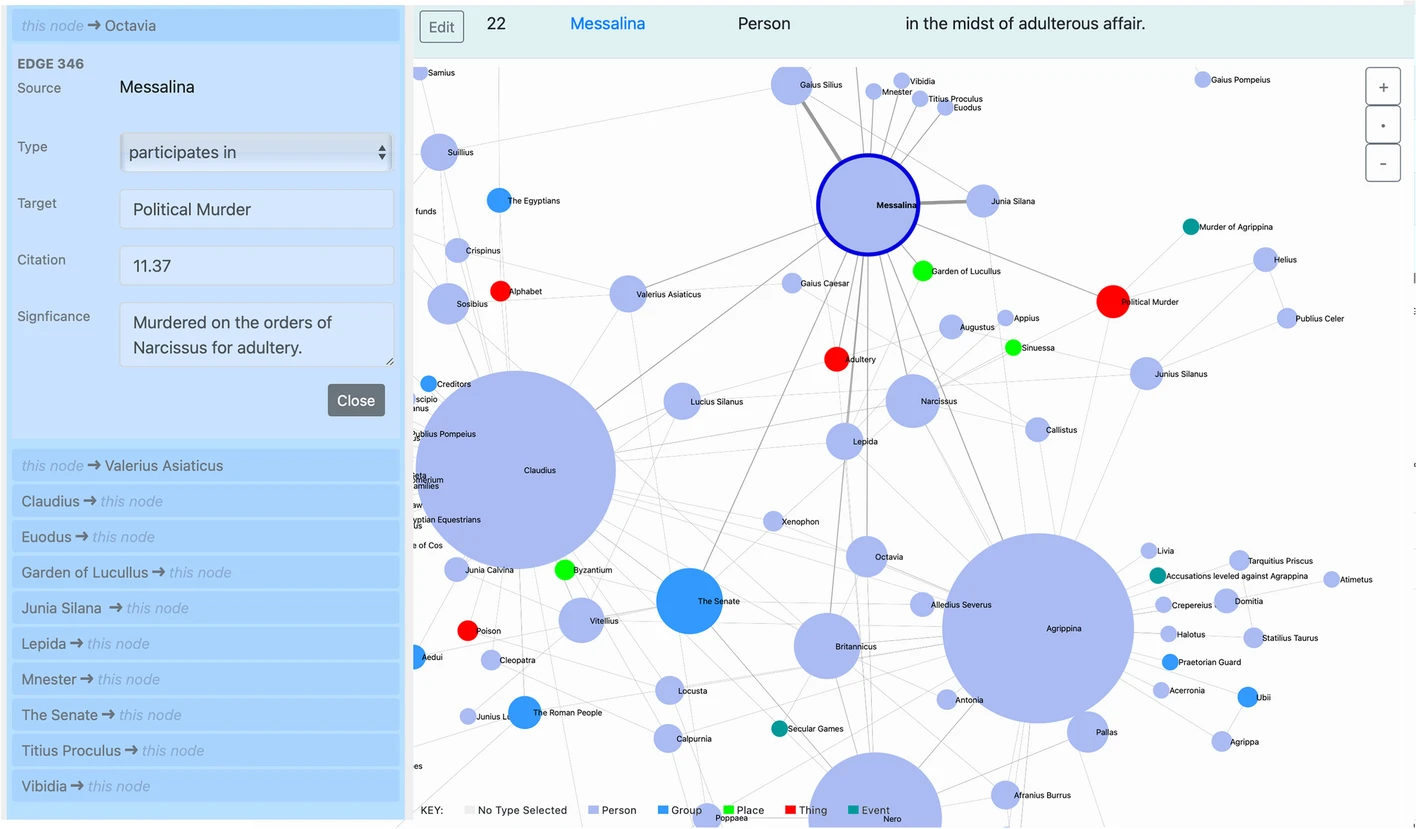
My research has been supported by $2.25 million in grant funding (2 NSF and 2 private-foundation grants) and includes digital-history tool design (Net.Create), digital public history endeavors (History Harvests and community archives), and argument-driven digital-history research (Sutton & Craig, DHQ 2022; Craig & Diaz, AHR, 2024). Each of my digital-history projects integrates digital-history tool design and methods development in different measure and with various collaborators that extend the impact of my work to other subfields within history as well as beyond the field of history.
Future Work
Several in-progress projects extend one or more of the 4 strands of my research. The first fully integrates the collaborative work that Mixed-Method Approaches to Collaborative History has enabled, the humanities-focused network analysis that Net.Create offers, and my digital-humanities capacity-building research to a new Net.Create grant submitted in January, 2025. The second is an ACLS Digital Justice grant for my community-archiving work that began in December 2024 and extends to June of 2026. Finally, I recently extended the Global Middle Ages Pilgrimage to include a public-interaction exploration of astrolabes and am in the early stages of transferring both digital-public-history exhibits into the newest community-archiving toolkit, bringing my medieval and digital-public-history skillsets together to make a scholar-sourcing platform for a new Global Middle Ages Pilgrimage that can be modified, adapted, added to, and localized for anyone interested in making medieval studies more publicly accessible.
I invite you to explore the digital-history scholarship in this interactive personal statement through in-text representative samples of public-facing supporting documents in the form of embedded links, screen captures, multimedia and interactive content.
Representative samples of documents with confidential information, (solicited letters for teaching and service, course evaluations, internal university documents, email with contact information other than my own) were made available to external reviewers via a shared-document folder and are in IU’s eDossier system.
Acknowledgements
Thanks to the American Historical Association for their Guidelines for the Professional Evaluation of Digital Scholarship by Historians, which ask historians to “consider new modes and forms of intellectual work within the discipline and to expand their understanding of what constitutes the discipline accordingly…, including new digital short-form genres such as blogs, social media or multimedia storytelling, developing and using new pedagogical methods, participating in strong activist forms of open-access distribution of scholarly work, or creating digital platforms and tools as alternative modalities of scholarly production.”
Thanks to Sharon Leon and Kathleen Fitzpatrick for their pioneering models of the public-dossier format; to my clinical-promotion committee for guiding my first public dossier; to Rebecca Wingo, whose more recent public dossier helped guide the restructuring of this dossier to focus on research; and to my tenure-case committee for helping shape this dossier.
 ORCID
ORCID