About Community Archive Digital Projects
My digital-tool design work for community archiving and digital exhibits speaks to a need to support archiving projects in a minimal-computing environment that requires limited expertise and money to set up and guides contributors through specific historical-thinking tasks.
Every day, we make history. It’s in what we eat, what we say, what we post to social media. It’s also in our homes, our backpacks and our classrooms. My digital-tool design work for community archiving and digital exhibits speaks to a need to support archiving projects in a minimal-computing environment that requires limited expertise and money to set up and guides contributors through specific historical-thinking tasks.
Digital Community Engagement as Historical Research
My work in digital community archiving started in the classroom, as part of a curricular-development project focused on undergraduate research experiences. In early 2019, I led a classroom of first-year researchers through the process of a History Harvest. That, in turn, led to a series of questions about the tools most commonly used for History Harvests.
The two primary considerations for an ethically shaped community archive are the archive’s longevity, and community control and ownershiip of an archive. Both shape the access future historians have to community-driven archives, the former by making access over a longer term possible and the latter by shaping future historians’ work based on community-driven principles of what should and should not be preserved. The latter makes it more likely that communities will fully engage with the interpretation and preservation of their own history.
With these disciplinary considerations in mind, I applied my experience with Net.Create’s DBHR process to the evaluation of community archiving workflows and identified several community and researcher needs:
- a low-cost approach to physical preservation tasks. A photo lightbox made of cardboard, tissue paper, and desk lamps made it possible to use smartphones instead of expensive DSLRs. This made preservation of more objects more likely.
- a low-cost approach to the web-site creation portion of a digital exhibit. This makes for a more stable archive and a larger archive (since larger web sites with more images are often associated with higher costs)
- a long-term digital-preservation strategy that results in a static site rather than a dynamically generated site. In less technical terms, that means a site that doesn’t use databases or heavy programming to generate the page for each item in a community archive. Static sites have a much longer life span and are less likely to need regular updates to be maintain their legibility.
I worked to identify templating needs with the Center for Research on Race, Ethnicity and Society, La Casa at Indiana University Bloomington, Jazma Sutton and the Remembering Freedom descendant community in Greenville and Longtown, Ohio, and ImaginX en Movimiento (IXeM, co-founded by Marisa Hicks-Alcaraz). Feedback from these, and other, partners, and observations made over several completed History Harvests, allowed for the revision of these tool features and workflow approaches that would encourage historical thinking, thoughtful archival practices, and community contributions.
My Role
Like Net.Create, the current community-archiving template is built around several Design-Based History Research adaptations.
Initially, I adapted an existing static-site template (https://www.wowthemes.net/mediumish-free-jekyll-template/) and used Jekyll and Github Pages to generate a digital-exhibit website for the first-year-research-project History Harvest in Spring of 2019. I then revised that theme adaptation in Fall of 2019, with the spring 2019 and a summer user-group test in mind. A third theme adaptation in Spring of 2020 to begin the Remembering Freedom web site, provided a clear platform for testing and an initial list of revision needs.
One primary revision priority came out of those three initial tests. Our adaptation of an existing website theme allowed us to build digital-exhibit information requirements for metadata, oral histories, and argument-driven histories into a digital exhibit. However, these themes were overly complex because they were designed to serve any website need any random internet user might have. In order to provide a digital-exhibit platform anyone could use, we needed something purpose-built for community histories.
I started building a Community-Archive Jekyll Theme template from scratch in winter of 2022 and completed a test version in early summer of 2022. Between 2022 and spring of 2024, I revised the original Community-Archive theme three times in response to new and ongoing community-archive projects, digital exhibits, and other related digital-humanities-scholarship and digital-public history needs, including this dossier.
In spring of 2024, the team identified a number of major changes that needed to be made that would result in existing sites functioning less well. Our successful receipt of an ACLS Digital Justice grant, which we received in April of 2024 and which began in December 2024, helped us revise the Community-Archive template and build a better sustainability plan. To address the major changes, we renamed the project DigitalArc and launched a beta version that includes screen-reader and contrast accessibility, full documentation, a demo site and a copiable sample site that will more readily support major revisions in the future.
Current Status
The DigitalArc Toolkit is available for use by any member of the public at https://digitalarcplatform.github.io . A beta version 0.9 was launched, with documentation, in May of 2024. Full testing with 6 partners will take place in late 2025 and early 2026, and the 1.0 version of DigitalArc will launch in 2026.
Resources and Guides
A Quick-Start guide provides a fast way to get a community archive going; estimated start-up time for first-time users is about an hour. The theme documentation provides more detail for digital historians and digital humanists seeking to customize the theme for their own use.
- Theme documentation. The team is actively engaged in documentation completion, with a deadline of May 2025 for the final section on using the newly-revised theme template
- Sample Site. This demonstrates how the site will look for users with small collections.
- Template to Copy. Users can press the “Use this template” button to copy the site and use the documentation to develop their own sites.
Future Plans
In addition to the ACLS-funded communities who will pilot the DigitalArc theme in 2025 and 2026, and a digital-dissertation publication theme based on DigitalArc which will launch in December of 2025, I’m engaged in planning for several upcoming community-archive or digital-history-exhibit projects, which will provide several rounds of public-history-driven revisions.
Examples of the community-archiving templates in action
- This dossier! One of my goals has been to advance digital-history and digital-humanities scholarly communication. Using the Community-Archive Jekyll Theme for this dossier provides an additional use-case example for other academics struggling to present their digital scholarship.
- Home Bound: Home Bound is an art exhibition curated by featuring artworks that each visualize aesthetic concepts of “home.”
- La Casa 50th Anniversary: IU Bloomington’s Latine student organization celebrated its 50th anniversary in October of 2023.
Full Funding & Publication List
Grants
2024
Michelle Dalmau (PI), Kalani Craig (Co-PI), Vanessa Elias (Co-PI), Jazma Sutton (Co-PI). Digital Justice Development Grant ($99,802) for "Archiving Out of the Box: Supporting Community Ownership of Shared Narratives through a Digital Archiving and Storytelling Kit". American Council of Learned Societies (ACLS). 2024-2025.
Digital History Publications
2024
DigitalArc Toolkit: a toolkit and minimal-computing website platform for community-owned storytelling and digital archiving. First release May 2024
https://digitalarcplatform.github.io.2022
"A Pilgrimage through the Global Middle Ages" with Medieval Studies at Indiana University. Organized, edited, and wrote contributions for a web-based public-history walking tour of IUB.
https://medieval.indiana.edu/globalpilgrimage/.2021
Minimal-computing Github Pages website template and programming for History Harvests. Released 2019. Current version: v3, 2021.
https://github.com/IUBHistoryHarvest/IUBHistoryHarvest.github.io.2019
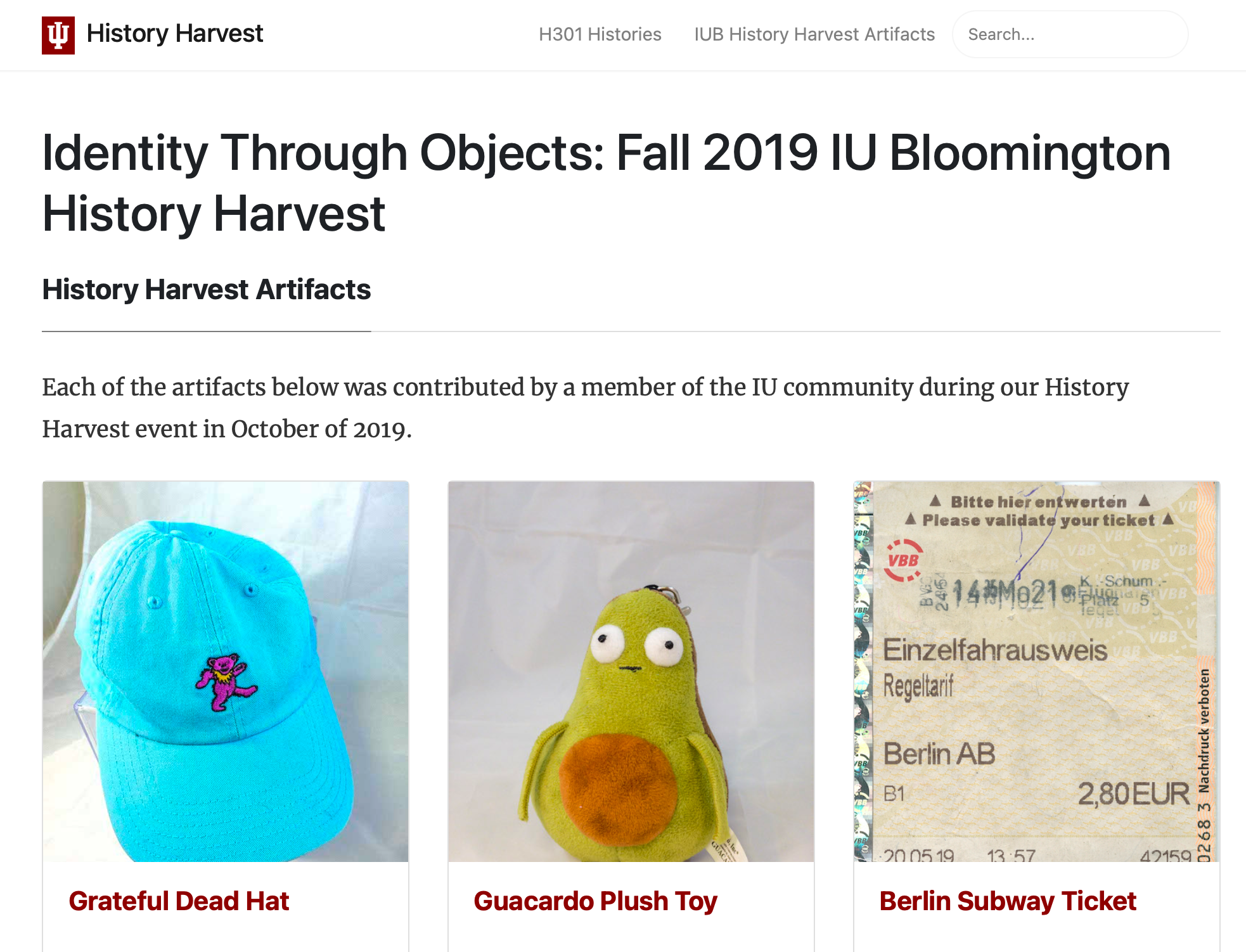
"Indiana University Bloomington: Identity Through Objects" with H301 Fall 2019 Digital History students, the Center for Research on Race, Ethnicity & Society and the Institute for Digital Arts & Humanities. History Harvest public event: Oct 2019; launch of website spring 2020.
https://historyharvest.indiana.edu/Fall2019/."Remembering Freedom: Longtown/Greenville History Harvest" with the Longtown/Greenville Descendant community, Jazma Sutton, Matthew Landini, the Center for Research on Race, Ethnicity & Society, and the Institute for Digital Arts & Humanities. History Harvest public event: Sept 2019; launch of https://longtownhistory.github.io, summer 2021
https://longtownhistory.github.io."Indiana University Bloomington Student History Harvest" with A200 Fall Spring First Year Research Experience ASURE Digital Public History students. History Harvest public event: March 2019; launch April 15, 2019.
https://dighist.indiana.edu/historyharvest/.Text Based Publications
2022
Michelle Dalmau, Kalani Craig, *Maks Szostalo, Michelle Moyd, *Jazma Sutton. "A Tale of Three History Harvests: Adapting Minimal Computing Approaches for Digital Public Humanities Projects" (under review, Nov 2022)
*Jazma Sutton, Kalani Craig, "Reaping the Harvest: Descendant Archival Practice to Foster Sustainable Digital Archives for Rural Black Women" in Digital Humanities Quarterly 16.3 "Between DH and Me: Special Issue on Black Studies in/for the Rising Digital Humanities Generation" (Aug 2022).
http://www.digitalhumanities.org/dhq/vol/16/3/000640/000640.html.