About Global Middle Ages Pilgrimage
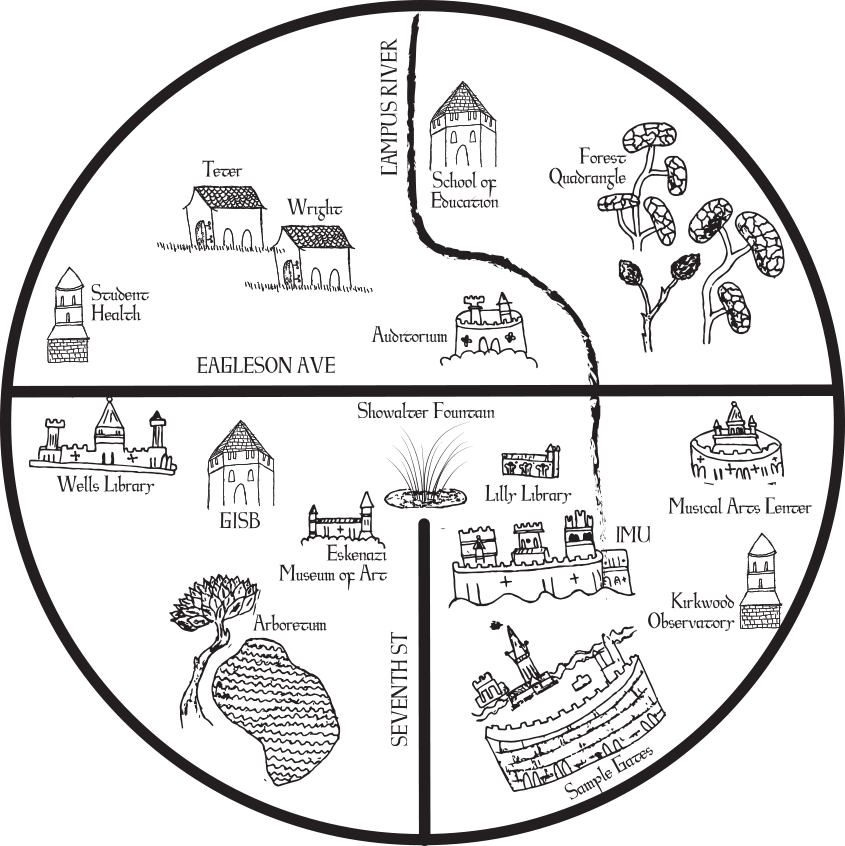
The Global Middle Ages Pilgrimage matches pilgrimages from all over the globe undertaken between 500 and 1500 and maps them onto locations at IUB that serve a similar purpose.
Global Middle Ages Pilgrimage as Research
Popular concepts of the Middle Ages—think Game of Thrones—draw on limited, mostly European, models of the world between 500 and 1500. The Global Middle Ages movement, on which there is substantial scholarship, helps mitigate the cooptation of the Middle Ages as a platform for white supremacists and celebrates the breadth of cultural, religious and social interchange that characterized the entire world between 500 and 1500.
At the same time, it’s necessary to complicate the idea of “medieval” as global by communicating to audiences that “medieval” is a peculiarly European label and other disciplines and geographies have their own labels for the period between 500 and 1500.
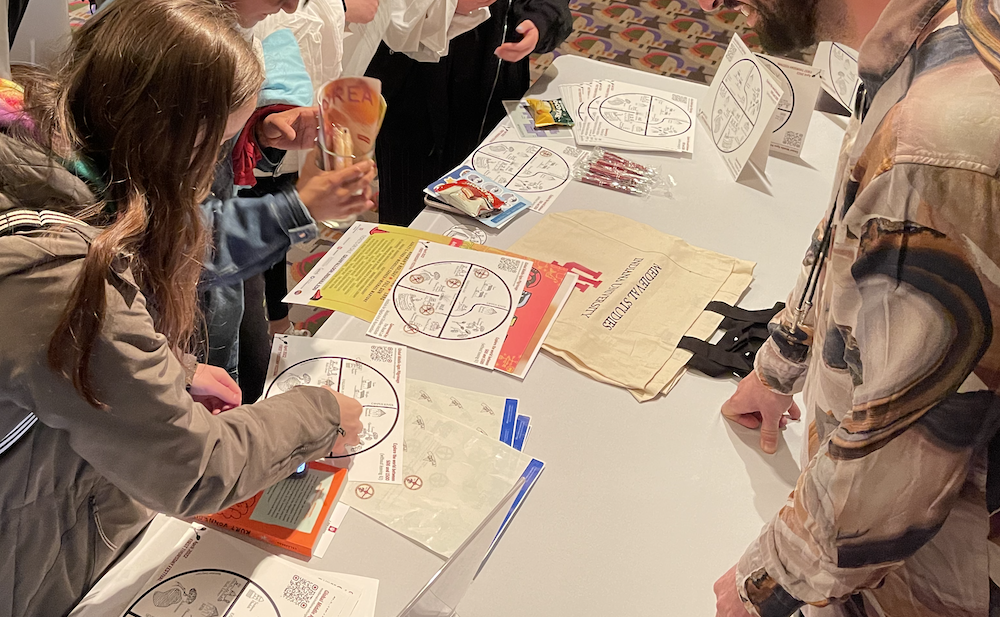
Together with many colleagues from IUB, Medieval Studies sought to communicate both of those complex ideas by rooting pilgrimages that were popular between 500 and 1500 in comparable sites at IUB. For instance, a pilgrimage through the forests of 9th-century Japan had a nice parallel in Dunn Woods, a dense forested oasis on the southwestern side of IUB’s campus. We also chose to hide the geographic origin of each pilgrimage so that visitors expecting European destinations would find themselves far afield globally. Finally, we fully described the original pilgrimage location in terms suited to that geography (so 9th-century Japan was “classical Japan”, not “medieval Japan”) and provide opportunities for visitors to connect with further IUB research and teaching resources on these pilgrimages outside of the pilgrimage route itself.
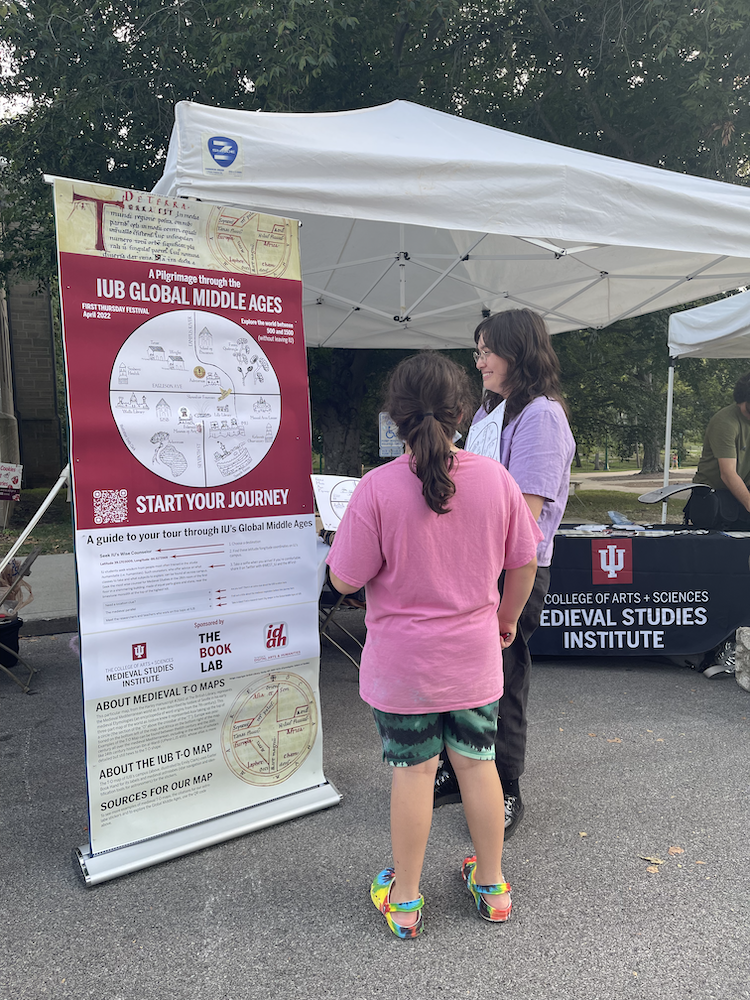
Under my leadership, staff from the Medieval Studies Institute and Institute for Digital Arts & Humanities guided attendees from the Bloomington community through choosing and documenting their Global Medieval Pilgrimage at a public festival, IU-Bloomington’s First Thursday Festival, in April and October of 2022.
For the full solar eclipse that crossed Bloomington’s path in 2024, Dr. Elizabeth Hebbard and I worked with Dr. Caterina Agostini and Pouyan Shahidi to extend the pilgrimage idea to include the navigational practices that allowed pilgrimages to happen, by building a digital-public-history activity around reproductions of astrolabes.
My Role
The most comparable role is that of an editor of a collected-essay volume. I designed the geospatial activity, proposed the public-history framework, researched and wrote the introductory and concluding material, recruited researchers for some of the pilgrimages and wrote others myself, and commissioned the T-O map of the IUB campus that mimics a map form commonly used in the medieval Mediterranean.
Future Plans
With the DigitalArc Toolkit now revised to better support a broader variety of digital-history exhibits, my next goal for the Global Medieval Pilgrimage is to solicit 10-15 additional pilgrimage entries from medievalist colleagues. In addition to these new pilgrimage descriptions, I also intend to add tags for each pilgrimage that address the topographic, architectural, religious, and intellectual features of each pilgrimage, so that any institution can take the Global Pilgrimage digital-public-history activity and match the medieval pilgrimages to locations in their own community. These new features will then allow me to layer a global-pilgrimage toolkit on top of the DigitalArc Toolkit so that communities can build their own global pilgrimage easily and for free using the same kinds of minimal-computing principles that drive my community-archive research.